


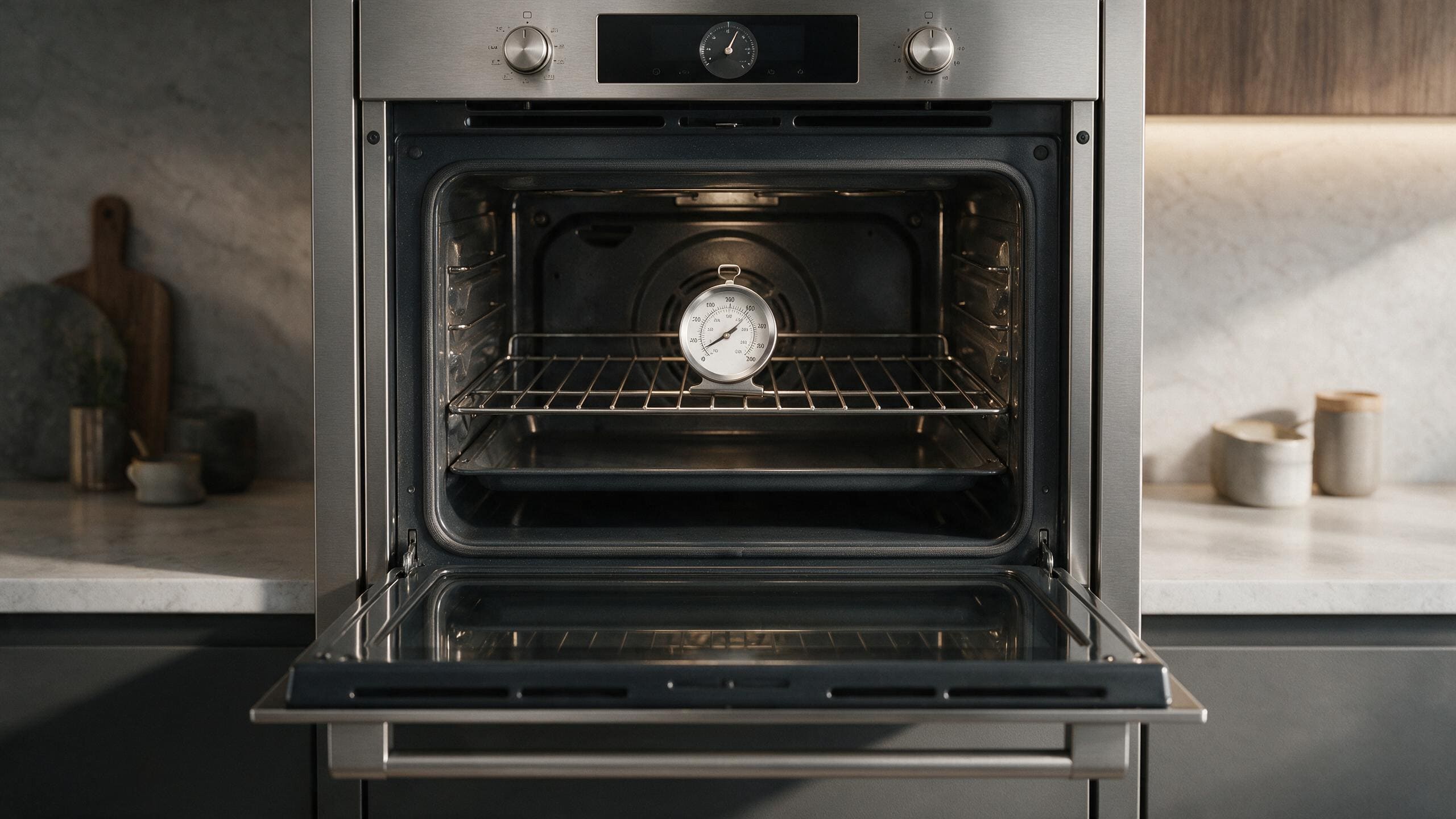
A Viking oven cycles around its setpoint, so one thermometer reading can be misleading. Compare a stable pattern before adjusting calibration.
An oven that seems to run at the wrong temperature is often just cycling, so one thermometer reading can mislead. Preheat fully, watch the reading across several heating cycles under the same conditions, and request a diagnosis only if the average stays consistently off or the cooking results back it up.
An oven does not hold one exact number continuously. Heating turns on and off as the control manages the cavity around the target.
That means one thermometer snapshot can make a normally cycling oven look inaccurate.
Place a reliable oven thermometer where the model guidance and normal cooking conditions make sense.
Allow the oven to preheat fully. Wait for the oven’s own preheat indication first, since an oven that has only just reached the set point is still settling.
The use-and-care manual for one Viking gas range lists an oven that has its indicator light on but is not heating as normal cycling, and says heating resumes after it cools. In other words, a period without heat can be part of how the control holds the cavity near the setpoint.
That is also why the thermometer location matters. A thermometer near the door, on a high rack, or against a side wall reads a different part of the cavity than one placed where the food will sit. Keep the thermometer in the same place for every test so the readings can be compared.
Instead of reading the thermometer once, observe the temperature over a period of normal cycling.
The useful question is whether the average behavior is consistently different from the setpoint and whether that difference matches the cooking complaint.
Note the time and the reading at the moment the heat comes on and again when it goes off. A swing that repeats the same way each cycle describes a stable control. A swing that changes shape from one cycle to the next is more interesting.
Use the same:
Avoid opening the door repeatedly to check the reading.
Different cooking modes manage the cavity differently, so a bake test and a convection test will not give matching readings. Pick one mode, run the whole test in it, and only then repeat the test in another mode as a separate comparison.
Room conditions and the electrical supply can also play a role. A mismatch that shows up only after electrical work in the home belongs in your notes, along with the date it started.
Calibration adjustments, where a model offers one, are described in the manual for that model. They shift the control’s offset and do not repair a heating or sensing fault, which is why a repeatable measurement should come first.
Finally, think about the thermometer itself. Inexpensive dial thermometers can drift and may read differently from one another. If two thermometers disagree in the same oven, neither reading should be used to judge the oven.
If the test shows a repeatable pattern, write down the set temperature, the mode, where the thermometer sat, and the highest and lowest readings you saw. A pattern described in those terms is far more useful than the impression that the oven is off.
Uneven browning can come from airflow or pan position even when average temperature is reasonable.
| What you observe | What it can point to | What you can check |
|---|---|---|
| Reading swings above and below the setpoint | Normal cycling | Average the readings over several cycles under the same mode |
| Reading is steady but consistently off | Thermometer position or a real offset | Move the thermometer to the food area and repeat the test |
| Food bakes differently than the thermometer suggests | Rack, pan, or airflow instead of temperature | Compare the same pan and rack position across tests |
| Reading is far off and unstable | Sensing, heating, power, or control problem | Stop troubleshooting and request a diagnosis |
| Error message appears with the odd temperature | A condition the control has detected | Photograph the display and use the Error Codes page for the exact message |
Use Viking Oven Bakes Unevenly: Test Rack Position Before Blaming Temperature for that symptom.
If the model allows a user calibration adjustment, only consider it after a repeatable measurement pattern.
A large or unstable error can involve temperature sensing, heating, controls, power, or airflow and should be diagnosed.
An oven that is far off, drifts from one day to the next, or shows a message on the display should not be pushed through more tests. Stop, keep the notes, and request a diagnosis instead of working around it with different set temperatures.
Yes. Each opening lets heat out and forces another heating cycle, which makes the readings harder to compare. Read the thermometer through the glass.
Heavy residue is not a measurement tool, but it can cause smoke or odors and can affect cooking results. Clean the oven following the manual instructions for your model before running a test.
It can, because the temperature is not identical in every part of the cavity. Use the rack position the manual recommends for the type of cooking you are testing.
For a repeatable temperature problem, request Viking Oven Repair.
Because the oven cycles.
Not automatically. Look at the pattern and cooking performance.
Only if the exact model manual provides a user adjustment and the measurement supports it.
Share a few details and we’ll confirm an appointment. Prefer to talk? Call us and we’ll help right away.
Use the secure scheduler below to request your appointment.