


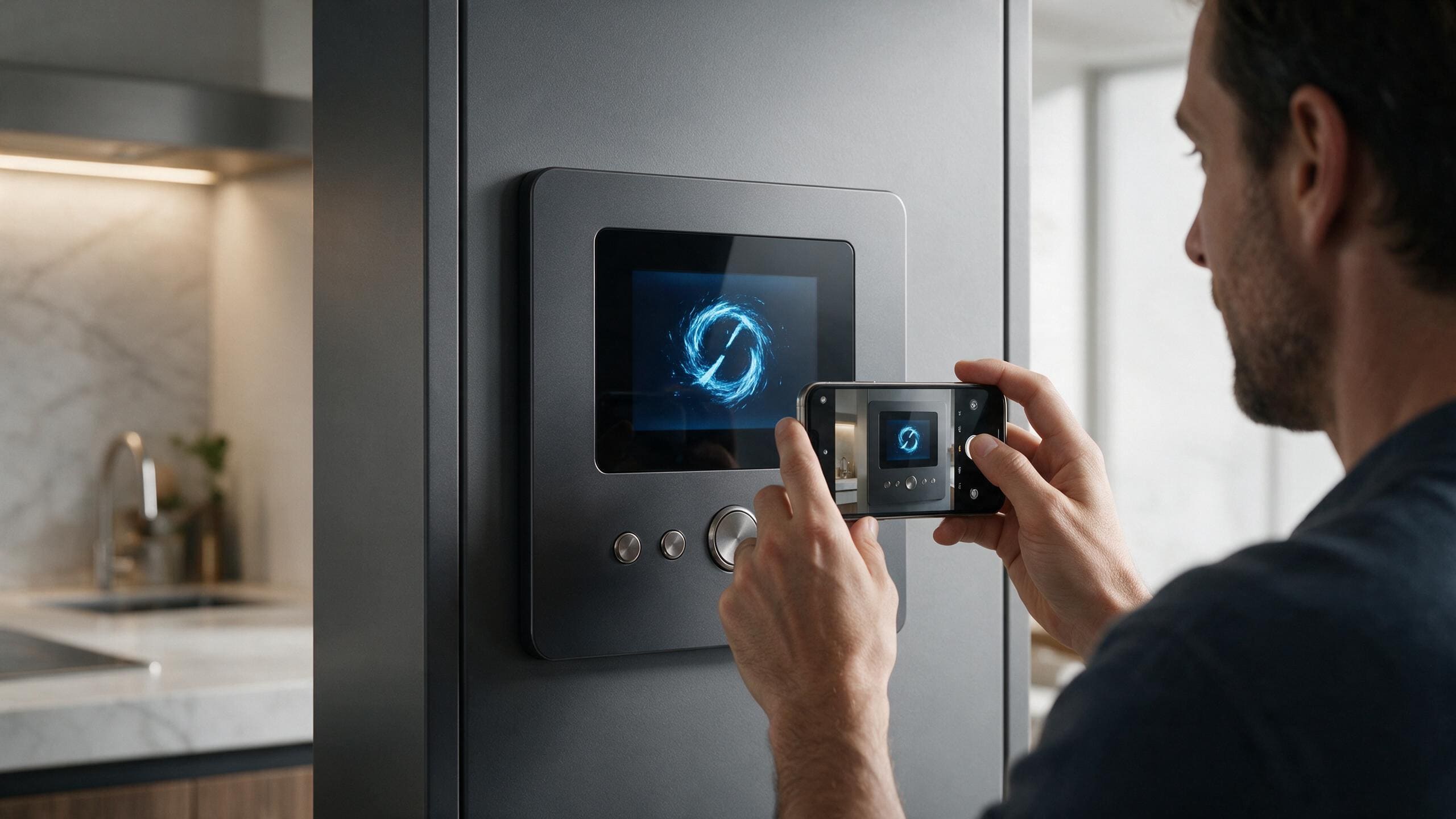
A Viking error code is most useful when you save the exact display, appliance type, model, cycle stage, and symptoms before resetting.
To keep an error code useful, photograph the whole display before touching anything, then write down which appliance showed it, the model label details, and what the appliance was doing just before. Clear the display only after that, and no more than once, because the context is what lets the code be read correctly.
An error code is a diagnostic clue. It becomes much less useful when the display is cleared before anyone records what the appliance was doing.
Capture letters, numbers, dashes, leading zeroes, and flashing-light patterns.
Do not rely on memory. E15, E:15, F15, and a flashing indicator can belong to different platforms. Even the same prefix can differ: on many Viking dishwashers a flashing E:02 icon is a documented water-supply warning, while other Viking appliances use entirely different message styles.
A short video can capture a flashing or alternating display better than a still photo. If the display scrolls or alternates, record the whole sequence, not one frame.
The same number can have a different meaning on a dishwasher, washer, dryer, oven, range, refrigerator, cooktop, or coffee machine.
Always match the appliance first.
Viking makes dishwashers, ranges, wall ovens, cooktops, refrigeration, ice machines, and hoods, and the control systems differ between them. The use-and-care manual for one Viking dishwasher lists E:01 for too much water or leakage and E:02 for a cut-off water supply. The manual for one Viking induction cooktop uses entirely different messages, such as E2 for overheating and Er03 for covered controller keys.
Some Viking appliances also communicate with patterns instead of numbers. The manual for one Viking gas range family says its error codes appear as a red backlight and a set number of knob-ring flashes, and it does not print a numeric table for owners. In that case, the count of flashes is the clue worth recording, and it should not be translated into a meaning from another appliance.
This is why the appliance type belongs in the record next to the code. Read the manual for your own model, and treat any meaning you find online as unconfirmed until it matches your appliance and generation.
Take a photo of the rating label if possible.
Viking product generations can use different controls and diagnostic logic even when the appliances look similar.
Write down:
That context can be more valuable than the code alone.
Context also helps when the code is intermittent. A code that appears only during one program, only after a door is opened, or only after a power interruption points to a different path than one that appears every time the appliance is switched on.
If the owner documentation provides a normal reset and there is no leak, electrical hazard, gas odor, or overheating, try it once.
If the same code returns, stop clearing the evidence.
| What you saw | Why it is worth recording | What you can safely do |
|---|---|---|
| Letters and numbers on the display | The exact format separates one control platform from another | Photograph the whole display, including any dashes or colons |
| Flashing icon or light pattern with no number | Some models signal with patterns, not text | Count the flashes or note which indicator blinks and photograph it |
| Code appears at a certain cycle stage | The stage narrows which system was active | Note the program and the point where it appeared |
| Code returns after one reset | The condition is still present | Stop clearing it and keep the original photo |
| Smoke, burning smell, water, or gas odor with the code | The safety issue comes before the code | Stop use and shut off power or supply at the breaker or valve if it is safe to reach |
Search the Viking Error Codes directory by appliance and exact code.
Do not use a random meaning from a different appliance family.
If the manual for your model does not list the code, that is a useful finding in itself. It means the message is meant for service reading, and the photo plus the model label is the right thing to hand over.
The photo is usually enough, as long as the code, the model label, and the appliance type are all legible. A single note about what the appliance was doing adds the context a photo cannot.
Some manuals describe only a few user-facing messages, and a gas range manual may state that codes appear as light patterns without a printed table. Do not borrow a meaning from another appliance. Provide the photo and the pattern so it can be read for your model.
That depends on the symptom. If there is a leak, a burning smell, overheating, or a gas odor, stop and shut off the supply that is safe to reach. For a minor warning with no other symptom, avoid repeated restarts and request a diagnosis.
For recurring codes, use the relevant Viking Appliance Repair Services page.
No. It identifies a detected condition or system path.
Include the model number and operating context too.
Record whether the symptom remains. Intermittent faults can still be diagnosed from a good history.
Share a few details and we’ll confirm an appointment. Prefer to talk? Call us and we’ll help right away.
Use the secure scheduler below to request your appointment.