


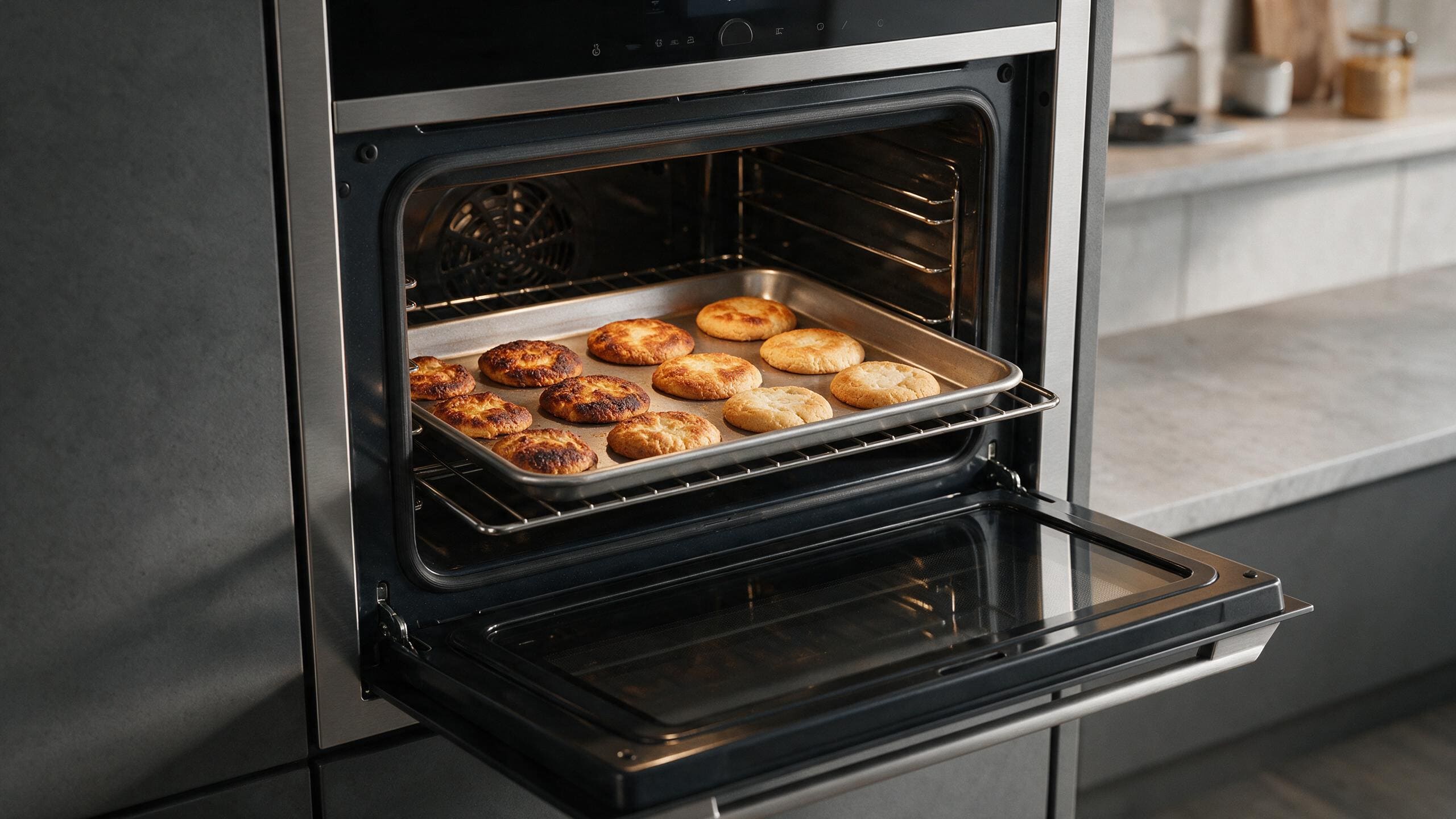
Uneven Viking oven baking can involve rack position, pan material, airflow, heating, sensing, or control. Build a repeatable comparison first.
When a Viking oven bakes unevenly, rack position, pan type, and crowding explain more than they get credit for, so test those before blaming the temperature. Repeat the bake with the same mode, rack, and pan, and request a diagnosis only if the same area still browns faster under controlled conditions.
Uneven browning is visible, but one tray of food is not a calibrated temperature test.
Before assuming a sensor or heating element failed, build a repeatable comparison.
Uneven browning has many possible sources, and the quickest ones to eliminate cost nothing. Start by writing down exactly where the food browns first: the back, the front, one side, or the bottom. That location is the clue the rest of the checks refer to.
Compare:
Changing all of those at once makes the result difficult to interpret. After the baseline, change one variable at a time so a better result can be credited to a single change. Keep notes in a simple list so the comparison is easy to repeat.
The use-and-care manual for one Viking gas range describes six rack positions, numbered from the bottom. It lists rack 2 or 3 for large flat pans, 2 and 4 or 3 and 5 for two-rack baking, and positions 2, 3, 4, and 5 for three-rack baking. Your own manual will list the positions for your model.
Position matters because the cavity does not heat identically at every level. A pan that sits too close to the bottom or the top gets more direct heat on one surface, and that can look like a temperature fault.
Oversized pans, foil placement, and tightly packed racks can change airflow.
Follow the oven manual for rack position and pan clearance. The manual for one Viking oven says to allow 1 to 2 inches of air space around each pan for even circulation.
The same manual lists baking-problem causes such as the wrong rack position, an oven that was not preheated, dark pans, too many pans, an oven or rack that is not level, and a door opened too often. Each of those is a quick thing to rule out.
It also says warped, dented, stainless steel, and tin-coated pans heat unevenly. A warped sheet pan that wobbles on the rack can give one side of the tray more browning than the other.
If you normally rotate food, note whether one area consistently browns faster before rotation.
A repeatable hot or cool zone across several comparable tests is more useful than one uneven batch.
| What you see | What it can point to | What you can check |
|---|---|---|
| Back or one side browns faster each time | Pan placement, airflow, or a heat pattern | Repeat with a lighter pan and a centered rack position |
| Bottom browns before the top | Rack too low or dark pan | Try rack 2 or 3 for large flat pans, per the manual |
| Only the first batch is uneven | Preheat or door opening | Preheat fully and keep the door closed |
| Uneven results with every pan and every rack | A heat or airflow condition worth diagnosing | Record mode, rack, pan, and the pattern |
| Oven also seems far off in temperature | Sensing or control | Run a cycling thermometer test |
| Door does not seem to close fully | Door sealing | Photograph the door edge and request service |
One more variable is the level of the oven and rack. The manual for one Viking oven lists an oven or rack that is not level as a baking-problem cause, which can leave batter or liquid pooled on one side.
Ovens cycle around the setpoint.
If temperature accuracy is part of the complaint, use Viking Oven Temperature Seems Wrong: How to Test a Cycling Oven.
Temperature and browning are related but separate. A pan can brown faster on one side because of airflow while the average cavity temperature is close to the setpoint, so judge them with separate tests instead of one.
A repeatable uneven pattern can involve:
None of these should be investigated by opening the oven or removing panels. The useful work for a household is the controlled comparison, and the model-specific testing belongs with service.
Those need model-specific testing.
Describe your tests in terms a technician can reproduce: mode, rack, pan, food, and the area that browns first. That description does more to narrow a diagnosis than a statement that the oven bakes badly.
Yes. The manual for one Viking oven lists an oven that was not preheated as a cause of baking problems, since food starts cooking before the cavity is ready.
Fewer than the oven can hold usually bakes more evenly. The same manual lists too many pans as a cause of uneven results, and recommends 1 to 2 inches of air space around each pan.
Foil placement can disrupt air movement, so follow your manual. Do not line the oven floor or racks unless the manual allows it for your model.
Use Viking Oven Repair when the problem remains repeatable under controlled conditions.
No.
Pan material and finish can affect cooking results.
Measure a consistent temperature pattern before changing calibration.
Share a few details and we’ll confirm an appointment. Prefer to talk? Call us and we’ll help right away.
Use the secure scheduler below to request your appointment.