


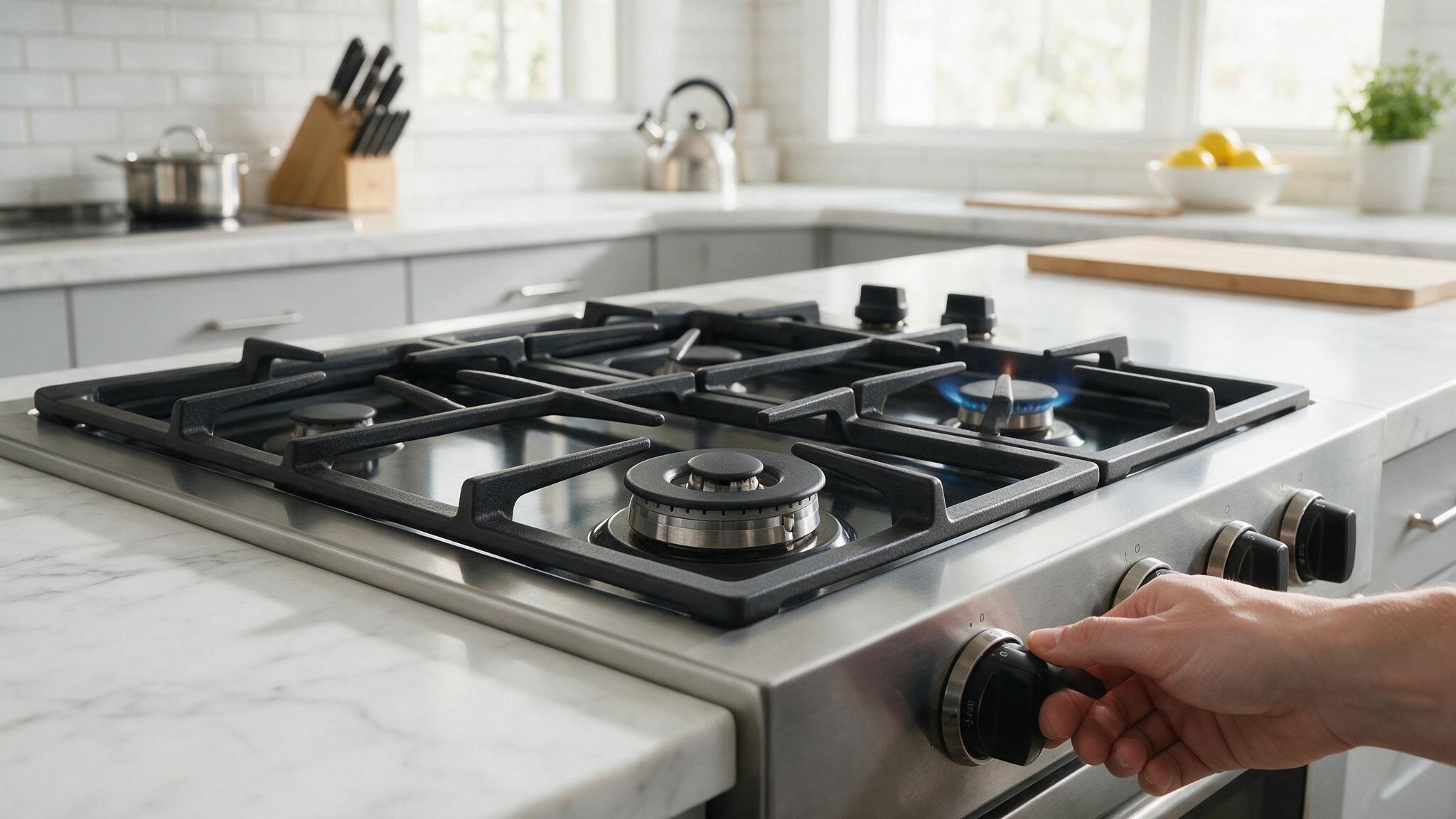
A Viking gas burner that clicks but will not light may have moisture, residue, cap-position, ignition, or gas-supply conditions. Keep checks external.
A gas burner that clicks but does not light often has a wet, dirty, or crooked cap, a gas supply that is off, or an interruption in the gas supply. If you smell gas at any point, stop trying to light the burner and follow the gas-safety steps. If the burner is dry and seated and still will not light, stop and request a diagnosis.
Clicking tells you the ignition system is attempting to create a spark. It does not tell you whether gas is arriving correctly or whether the burner is assembled and dry enough to light normally.
Do not continue repeated ignition attempts.
Follow the appropriate gas-safety procedure and avoid creating another flame or spark.
The use-and-care manual for one Viking range says that if you smell gas you should not light any appliance, touch electrical switches, or use a phone in the building. It says to call the gas supplier from a neighbor’s phone, and to call the fire department if the supplier cannot be reached.
Moisture around the burner and ignition area can affect lighting.
With the cooktop cool and power/gas controls in the normal off position, allow removable parts to dry.
The manual for one Viking range says all burners use electric ignition with no standing pilots. To light a burner you push in and turn the knob counterclockwise to any ON position, because the knob is both a gas valve and an electric switch. The igniters spark, and they reignite automatically if the flame goes out while gas is flowing.
Per the same manual, you should hear a clicking sound at every surface igniter. If you do not, turn off the control and check that the unit is plugged in and the fuse or breaker has not tripped. Because the igniters are electric, the manual also says they will not work in a power failure, and no attempt should be made to light the appliance until power returns.
If your model uses a removable cap, make sure it is seated in its normal position.
Do not file, drill, or enlarge burner openings.
That manual describes a burner head with two tabs that line up with the edge of the burner base and keep clear of the igniter, with the cap level and the arrow pointing to the back of the range. A cap seated off-center can block the flame path, so clicking continues but nothing lights.
If one burner fails while others operate normally, record that difference.
If all burners are affected after a gas-supply interruption, the diagnostic context is different.
The troubleshooting section of the manual for one Viking range lists these conditions: igniters not working means a tripped circuit, a blown fuse, or no connection to power. Igniters sparking but no flame means the gas supply valve is off or the gas supply was interrupted. Igniters sparking continuously after the flame lights means the power supply is not grounded, polarity is reversed, or the igniters are wet or dirty.
| What you hear and see | What it can point to | What you can safely check |
|---|---|---|
| No clicking at all | No power to the igniters | Check that the range is plugged in and the breaker or fuse has not tripped, per the manual |
| Clicking, no flame, no gas smell | Wet or misplaced burner parts, or the gas supply valve or supply | Dry and reseat the removable parts and confirm the supply valve is in the position your manual describes |
| Clicking continues after the flame lights | Wet or dirty igniter, or a power supply condition | Let the area dry and clean what the manual lets you clean |
| Clicking with a gas smell | Immediate safety issue | Stop, do not light anything, leave and call the gas supplier |
| Only one burner affected | Condition at that burner | Compare it with the others and record the difference |
| All burners affected after an outage | Supply or power event | Wait until power or supply returns and test normally |
Does the burner click continuously? Does it light and then go out? Does the spark appear only intermittently?
Those details help a technician separate external burner conditions from ignition, valve, wiring, or control faults.
Do not:
No. A match bypasses the ignition system and puts a flame near a burner that may be filling with unburned gas. The manual for one Viking range says to not attempt to light the appliance in a power failure. Follow your own manual, and request a diagnosis instead.
Moisture, residue, or a slightly crooked cap can slow ignition. If it keeps happening, dry and reseat the parts, and if the delay persists, request a diagnosis.
The igniters on a range are linked to the same control, so clicking can occur at other burners when one is lit. That is normal; the clicking should stop once the flame is established.
Use Viking Cooktop Repair and Safe Viking Troubleshooting: What You Can Check Without Opening the Appliance if the burner still will not light.
It means the system is attempting ignition; the complete spark/gas condition still needs evaluation.
Residue or moisture can cause a no-light condition, but not every ignition fault is a cleaning problem.
Share a few details and we’ll confirm an appointment. Prefer to talk? Call us and we’ll help right away.
Use the secure scheduler below to request your appointment.