


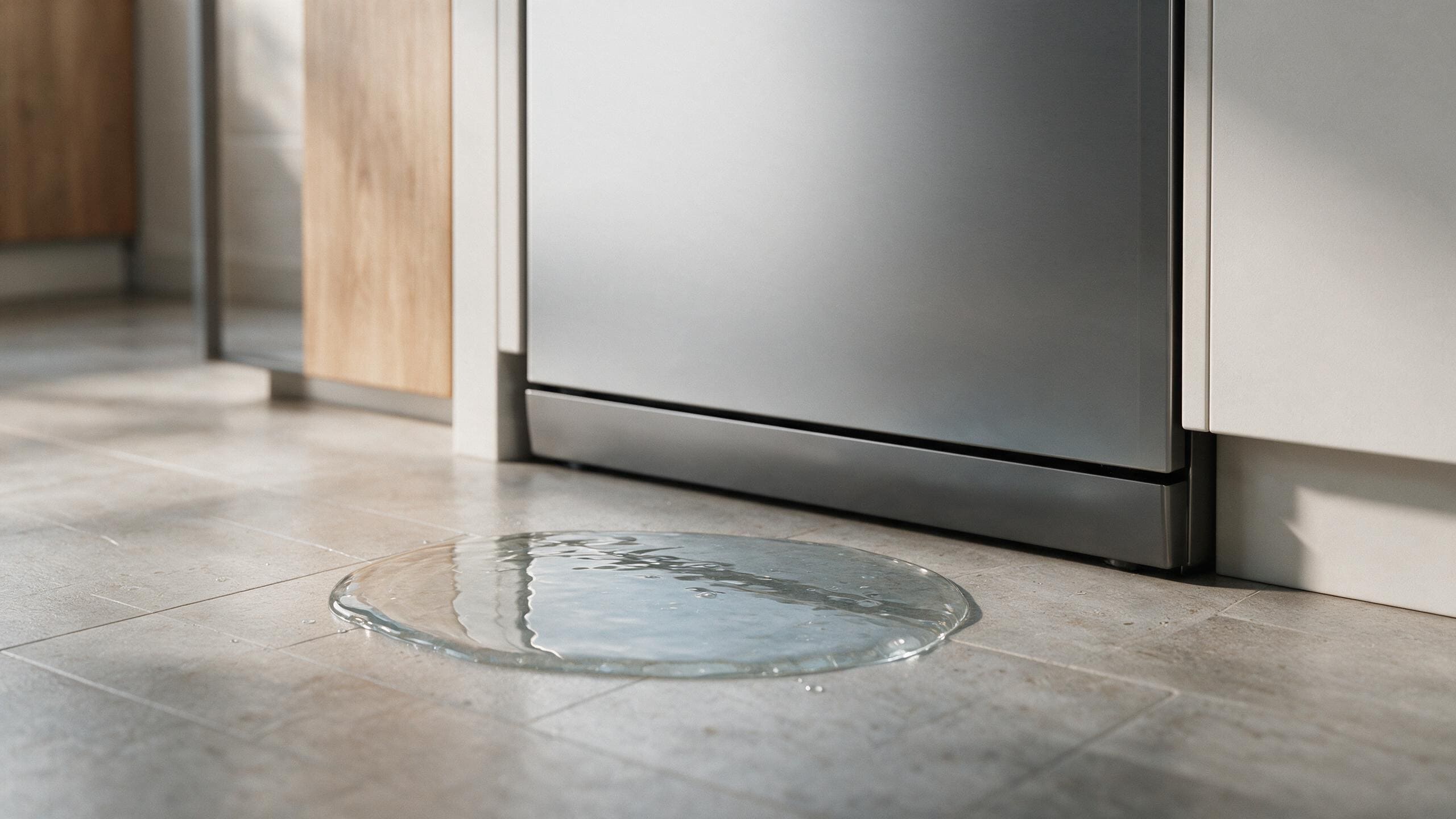
A Viking dishwasher leak is easier to diagnose when you record where the water appears and which cycle stage produces it.
Water around a Viking dishwasher is easiest to narrow down by when and where it appears: during filling, during circulation, during draining, or only after the cycle ended. Stop the machine, shut off the water supply if it is safe, and note the timing and location before requesting service.
A puddle tells you that water escaped. The timing tells you much more.
Water near the front during filling can come from a different path than water appearing underneath during circulation or near the end of drain.
A dishwasher moves water in stages. It takes water in, circulates it through the spray arms, and then pumps it out. Each stage uses a different path, so the stage at which water appears points to a different area to inspect first.
A leak that shows up only during circulation involves water under spray pressure, which can reach the door edge or escape from a path that is quiet at other times. One that appears at the end of the cycle may be related to draining or to the drain connection.
None of this identifies a part. It tells a technician where to begin looking, and it prevents the first visit from being spent reproducing the problem.
If the leak is active, stop the dishwasher and shut off the water supply when it can be done safely. Dry the area only after you have photographed it, so the location and extent of the water are on record.
From a safe external position, note whether water appears:
Do not pull an integrated dishwasher out of the cabinet simply to inspect underneath.
Look at the floor and the cabinet beside the machine as well, since water can travel along a surface before it becomes visible. A damp cabinet wall or a wet spot near the sink side can mean the water started somewhere other than where the puddle formed.
Did the leak appear:
That timing can help a technician choose the first inspection path.
| When the water appears | What it can point to | What you can safely check |
|---|---|---|
| While filling | The supply side, the door edge, or the inlet path | Look at the visible supply connection and shut off the valve if water is active |
| During wash or circulation | Spray escaping at the door, loading, or foam | Check that nothing blocks the arms or the door, and note excess suds |
| During draining | The drain side or the drain connection | Look at the visible drain hose connection near the sink, without moving the machine |
| Only after the cycle | Water left in the tub or a slow-draining path | Look for standing water and check the filter as the manual describes |
| Constant, even when idle | A supply side condition | Shut off the water supply and request service |
| With an error message | A condition the control has detected | Photograph the message and match it to the manual for your model |
If the dishwasher displays E15 or another water-protection warning, photograph the code.
Do not tilt the machine to empty the base so the code disappears. A cleared display does not fix the water source.
Viking dishwasher manuals list different warnings. The use-and-care manual for one Viking 3 and 5 Series dishwasher says an E:01 flashing means the machine takes in too much water or detects leakage, that it tries to discharge water, and that E:01 clears if the overflowing stops. If it does not clear, the manual describes a permanent fault and says to contact service. The same manual lists E:02 for a cut water supply. Check which messages your own manual lists, because meanings differ across product lines.
Use Viking Dishwasher Error Codes for the exact warning.
Check only what is safely visible:
Internal hoses, pumps, seals, valves, and electrical components need service access.
A damaged hose, a loose-looking connection, or fresh plumbing work are worth recording, but the absence of any of them does not clear the supply and drain lines. Many of those parts are hidden behind the kick panel or inside the cabinet.
Excess foam is a visible, manual-level clue. If suds are coming out of the door, the detergent or rinse conditions may be responsible, and the machine may still be working as designed. If suds are not present and water is, the cause is elsewhere.
Not if the leak is active. Repeated cycles can spread the water and damage flooring or cabinetry. Use the timing and location you already have.
A filter that is blocked can lead to water standing in the tub, and the manual for one Viking dishwasher lists clogged filters among the causes of water left at the end of a program. Check your manual for the filter steps.
Not necessarily. Check the manual for your model for what is normal at the end of a cycle. Standing water that stays after the program is a separate drain question.
Request Viking Dishwasher Repair with the model/E-Nr, leak location, cycle stage, and code.
No. Loading, foam, spray behavior, alignment, and other water paths can create front-area leaks.
A leak-protection warning should not be treated as a reset-only condition.
Leave built-in removal to a planned service process.
Share a few details and we’ll confirm an appointment. Prefer to talk? Call us and we’ll help right away.
Use the secure scheduler below to request your appointment.