


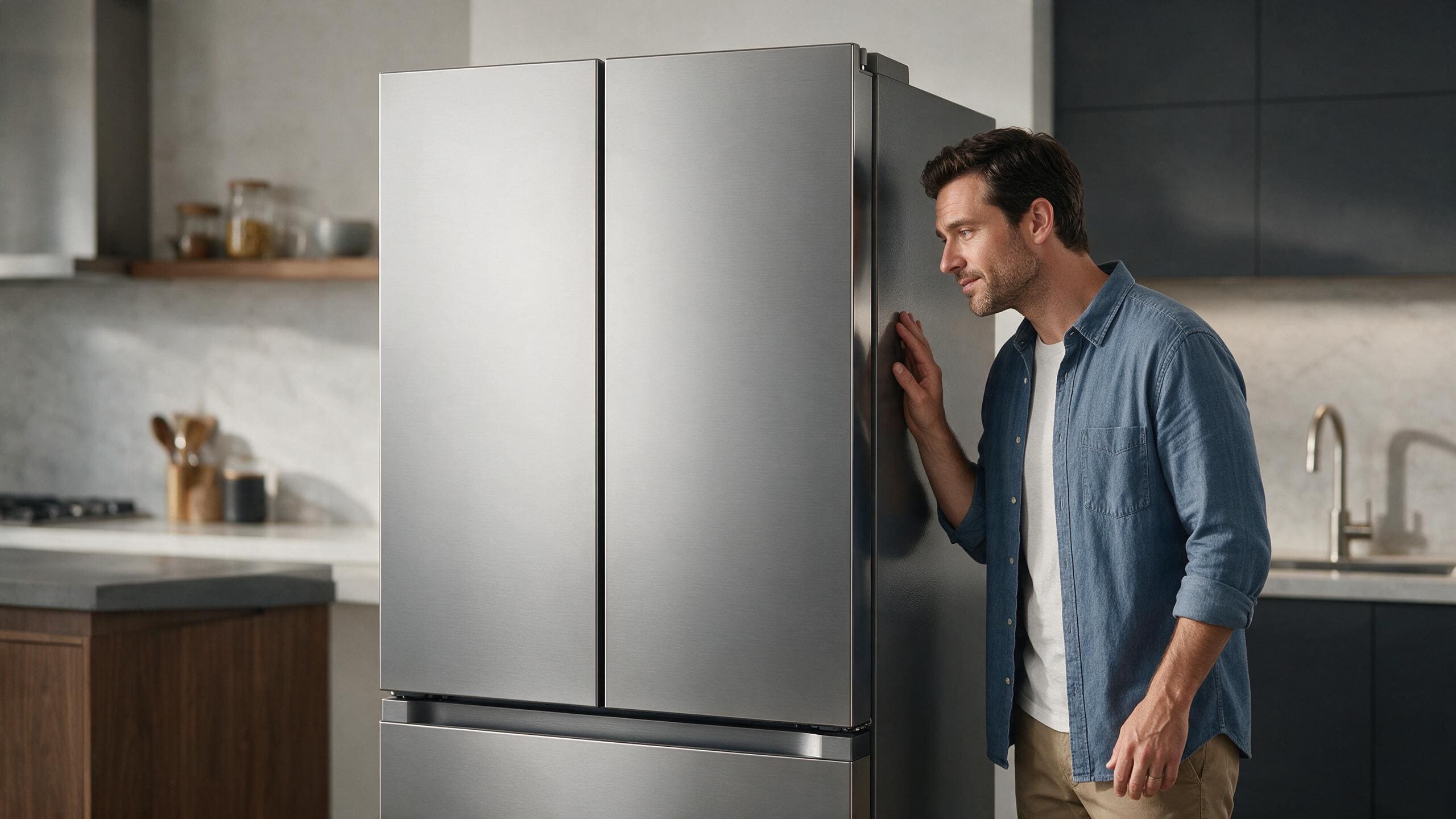
New Viking refrigerator noise is easier to diagnose when you record when it starts, what changes it, and whether cooling is affected.
A new noise from a Viking refrigerator is worth sorting by type and timing before you decide it is a fault: a rattle that stops when you move a bottle or level the cabinet is usually a vibration source, while a harsh grind, a scrape, or a click-and-stop pattern with a warming cabinet needs service. Compare the sound with a temperature reading. If the sound comes with an electrical odor, sparking, or breaker trips, leave the refrigerator off.
Refrigerators normally make more than one sound. Fans start and stop, refrigerant moves, the compressor changes operating state, and ice systems can produce short mechanical noises. A new sound becomes useful diagnostic evidence when you connect it to timing and performance.
Instead of “it is loud,” note whether the sound is:
Then record when it occurs. Does it start after a door closes? During ice production? When the compressor begins a cooling cycle? Does opening a refrigerator or freezer door change it? Timing against the cooling cycle is the detail a technician can use most.
Check bottles, bins, shelves, and objects on top of or beside the refrigerator. Two glass containers touching can amplify a small vibration into a surprisingly loud rattle. If a rattle goes away when you press on the cabinet or move one item, you have found the source and no part has failed.
Make sure the cabinet is not physically contacting nearby furniture in a way that transfers vibration. A refrigerator that touches a wall or cabinet on one side can carry its normal vibration into the room as a hum.
Do not remove rear covers to “find the fan” while the appliance is powered.
| Symptom | What it can point to | What you can safely check |
|---|---|---|
| Rattle or buzz that changes when you touch items | Bottles, bins, or objects on top vibrating | Separate touching containers and clear the top of the cabinet |
| Vibration or hum that changes with position | Cabinet not level, or contact with nearby furniture | Check the level and clearance around the sides |
| Fan-like whirring that stops and starts | Normal cycling of the cooling system | Note whether temperature holds steady |
| Scrape or harsh grind with rising temperature | A fan or mechanical fault | Measure temperature and book service |
| Short clicks near the ice maker | Ice-making activity | See whether the sound lines up with ice production |
Noise without a performance change can have a different priority than noise plus a warming compartment. A noise that comes and goes while the temperature stays steady is a different priority from one that grows as the cabinet warms.
Take an actual temperature reading. If the refrigerator is cooling normally and the sound is brief and repeatable, the information is still worth recording. If temperature is rising or the sound is a scrape, repeated start-click-stop pattern, or harsh mechanical grind, service becomes more urgent.
Viking manuals describe a few sounds as part of ordinary operation. The manual for one 7 Series bottom-mount refrigerator says a motor that runs for long stretches is normal on hot days, with large food loads, or when doors open often. A 5 Series built-in uses one variable-speed compressor and a 7 Series uses two, per Viking’s owner support page, so sound can differ between series even in the same kitchen.
Ice production adds its own mechanical noises, since the manual describes seven to nine batches per 24 hours on that bottom-mount model. A sound at those moments is therefore not alarming by itself.
For Viking’s undercounter wine cellar, the manual lists noise and vibration under two causes: an appliance that is not level, or a fan hitting an obstruction. The same two ideas apply to a refrigerator. A cabinet that is out of level can hum or rattle against its surroundings, and anything near the visible vent openings can interfere with air movement. Check those before assuming a failed part, and do not open covers to reach a fan.
Leave the refrigerator off if the new sound is accompanied by electrical odor, sparking, repeated breaker trips, or visible overheating.
A technician can compare the sound with fan operation, compressor/inverter behavior, ice mechanisms, and model-specific components.
Use Viking Refrigerator Repair for service and the Viking Models directory to confirm the full model before diagnosis.
The manual for one Viking refrigerator describes long running as normal on hot days, with large food loads, and with frequent door opening. If the cabinet is cooling well, longer run time is not a fault.
Common non-fault reasons are a cabinet that is not level, contact with nearby furniture, or loose items resting on or beside it. The wine-cellar manual lists an unlevel appliance and a fan hitting an obstruction as the causes of noise.
Some mechanical noise accompanies ice production, and one bottom-mount manual lists seven to nine batches per 24 hours. A harsh grind or a sound that repeats without ice being made deserves a closer look.
A short video or audio clip, the full model/E-Nr, and a note about when the sound occurs are more useful than trying several resets.
A recording can help, but it is not a complete diagnosis. Several components can create similar sounds.
Not necessarily. Record the sequence and whether cooling changes.
Not if it becomes harsh, continuous, or appears with rising temperature.
Share a few details and we’ll confirm an appointment. Prefer to talk? Call us and we’ll help right away.
Use the secure scheduler below to request your appointment.