


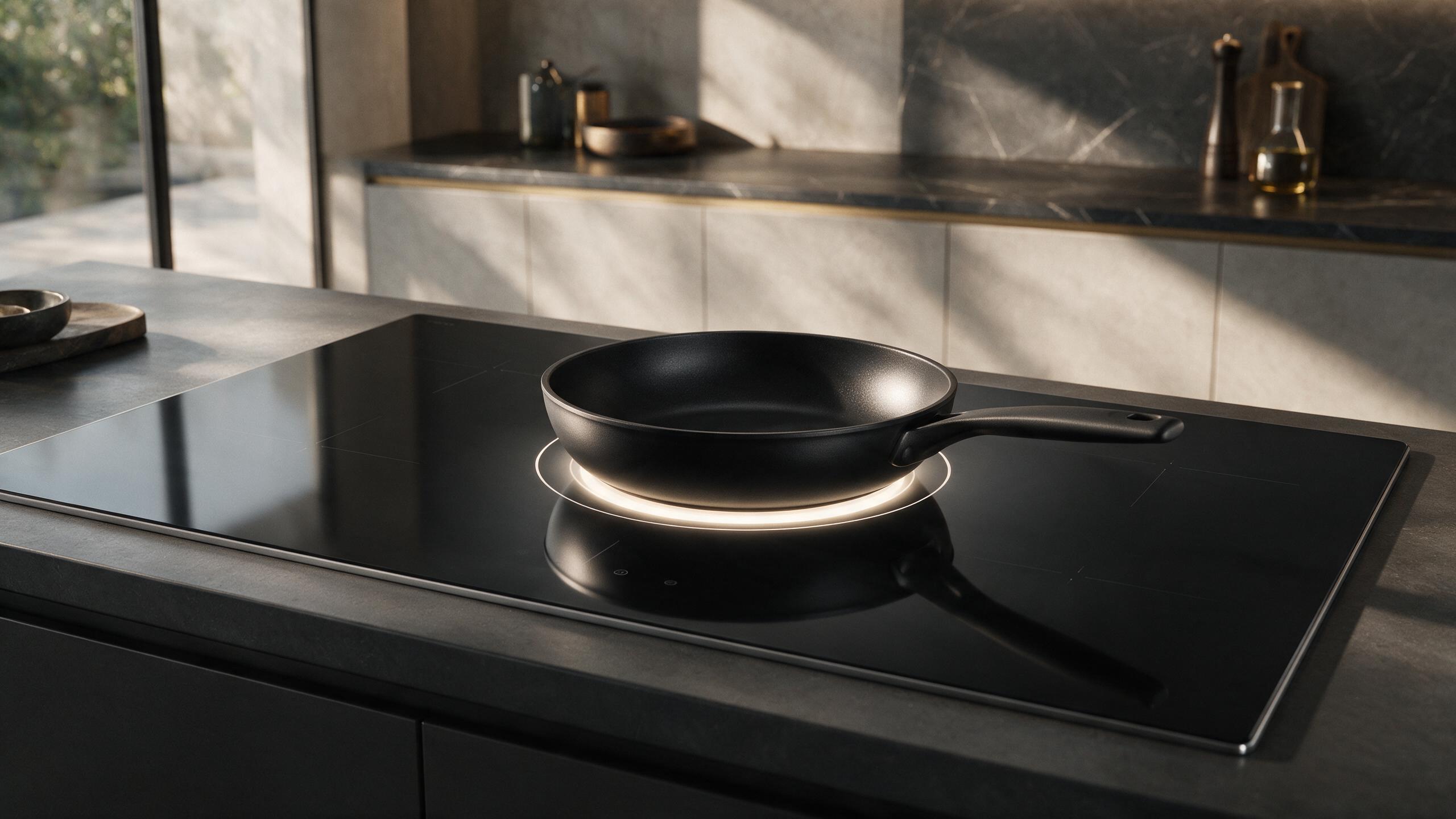
When only one induction zone fails while other zones work, cookware fit, zone sensing, a shared power module, coil/sensor, or control path becomes more relevant than total supply loss.
If only one induction zone is dead, test cookware first. Put a pan that is known to work on another zone onto the dead one, then put your original pan on a working zone. If the zone still fails with a good pan, request service.
When only one induction zone fails while other zones work, cookware fit, zone sensing, a shared power module, coil/sensor, or control path becomes more relevant than total supply loss.
An induction cooktop with three working zones and one dead zone gives a much more focused symptom than a completely unresponsive cooktop. Household power is present and the user interface may be functioning, but the affected zone still has its own cookware-detection, coil, temperature-sensing, and power-electronics path.
Start with cookware because it is the lowest-risk variable. Then stop before accessing the glass or induction modules.
The objective is not to prove a component bad from the kitchen. It is to rule out the obvious external conditions and preserve enough detail for model-aware testing.
Swap variables deliberately. Use a pan that is known to work on another zone, then use the original pan on a working zone. That simple cross-check separates cookware from zone-specific behavior.
A useful observation has three parts: what the appliance was asked to do, what it actually did, and when the difference appeared. That format is more useful than a broad label such as “broken,” “not working,” or “acts weird.” It also prevents a temporary installation or operating condition from being mistaken for a failed component.
Pan fit, zone sensing, a shared power module, the coil or sensor, or the control path may be at fault. Because other zones work, total supply loss is less likely.
Induction requires magnetic cookware and a base appropriate for the zone.
Off-center or warped cookware can be detected inconsistently.
An overheated zone/module can reduce or stop output until conditions recover.
A zone can fail independently if its sensing or coil circuit is abnormal.
Some induction platforms group zones on electronic modules, so a one-zone symptom still needs model-specific mapping.
These are diagnostic directions, not a replacement-parts list. More than one condition can exist at the same time, and the same visible symptom can be produced by different systems on another Viking model.
Do only the checks that are normal owner tasks for the exact product. If a step would require removing a service panel, moving a built-in appliance, disconnecting a gas fitting, opening a sealed refrigeration circuit, or measuring live voltage, skip it.
Induction systems use high-power electronics beneath the glass. Cookware detection, zone sensors, generator modules, cooling, and user controls can create similar outward symptoms, while internal measurements remain service-level work.
That is also why a generic search result should not be allowed to overwrite the model number. Exact model identity belongs with the symptom, any displayed code, and the installation style when service is requested.
Stop for burning odor, arcing, cracked glass, uncontrolled heating, or repeated breaker trips. Induction electronics carry hazardous voltages even after the cooktop is switched off.
After cookware, controls, cooldown, and user-visible ventilation are ruled out, further diagnosis reaches high-voltage power electronics under the glass. Do not remove the cooktop for exploratory testing.
A technician can map the affected zone to its coil, temperature sensor, generator/power board, harness, user-interface command, and supply path while following the exact model service information.
A proper diagnosis should connect each test to the symptom instead of replacing expensive assemblies until the problem disappears. Ask what was verified, what failed the test, and how that finding explains the behavior you reported.
This information is particularly useful for intermittent problems because the appliance may behave normally by the time a technician arrives.
Preserving evidence matters. A photo of an alarm, the exact burner that behaves differently, the water level after a drain cycle, or the temperature trend over several hours can save more diagnostic time than another power reset.
A practical decision depends on safety and function. Stop using the appliance when the symptom involves gas odor, active water near electricity, smoke, arcing, uncontrolled heat, repeated breaker trips, unsafe food-storage temperature, or a powered mechanism that is binding. Monitor briefly only when the symptom is mild, the appliance remains safe, and the checks above are producing useful evidence. Book diagnosis when the same symptom returns under normal conditions or when confirming the cause requires internal testing.
For built-in and premium installations, access is part of the job. Tell the service team if the appliance is panel-ready, tightly built into cabinetry, installed outdoors, behind custom millwork, or connected to a hard-to-reach shutoff. That helps the visit begin with the right plan rather than moving the appliance unnecessarily.
Use model pages for exact-model identity and the error-code library for exact code meanings. This article is intentionally focused on the symptom and decision path, so those page types can support one another.
The cooktop clearly has some power, but that does not rule out a zone-specific module, coil, sensor, harness, or a supply issue affecting only part of the electronics.
Record any code or light pattern first. One normal model-approved restart can be useful when the condition is safe, but repeated resets can hide useful evidence without correcting the cause.
No. The symptom narrows the system to investigate, but installation, utilities, wiring, sensors, controls, and mechanical components can create similar behavior.
Viking has multiple product families and generations. The model number determines the control platform, component layout, documentation, and the correct service procedure.
Send the full model number, the exact symptom, any code or display photo, when it occurs, what still works, the safe checks already completed, and your ZIP code.
If Viking induction one zone not heating is still the problem after the safe checks above, send the complete model number, the symptom or display photo, what still works normally, and your service-area ZIP code. Simply Iconic can use that information to plan model-aware diagnosis rather than guessing from the symptom alone.
Book a Repair
Phone: (844) 363-0467
The cooktop clearly has some power, but that does not rule out a zone-specific module, coil, sensor, harness, or a supply issue affecting only part of the electronics.
Record any code or light pattern first. One normal model-approved restart can be useful when the condition is safe, but repeated resets can hide useful evidence without correcting the cause.
No. The symptom narrows the system to investigate, but installation, utilities, wiring, sensors, controls, and mechanical components can create similar behavior.
Viking has multiple product families and generations. The model number determines the control platform, component layout, documentation, and the correct service procedure.
Send the full model number, the exact symptom, any code or display photo, when it occurs, what still works, the safe checks already completed, and your ZIP code.
Share a few details and we’ll confirm an appointment. Prefer to talk? Call us and we’ll help right away.
Use the secure scheduler below to request your appointment.