


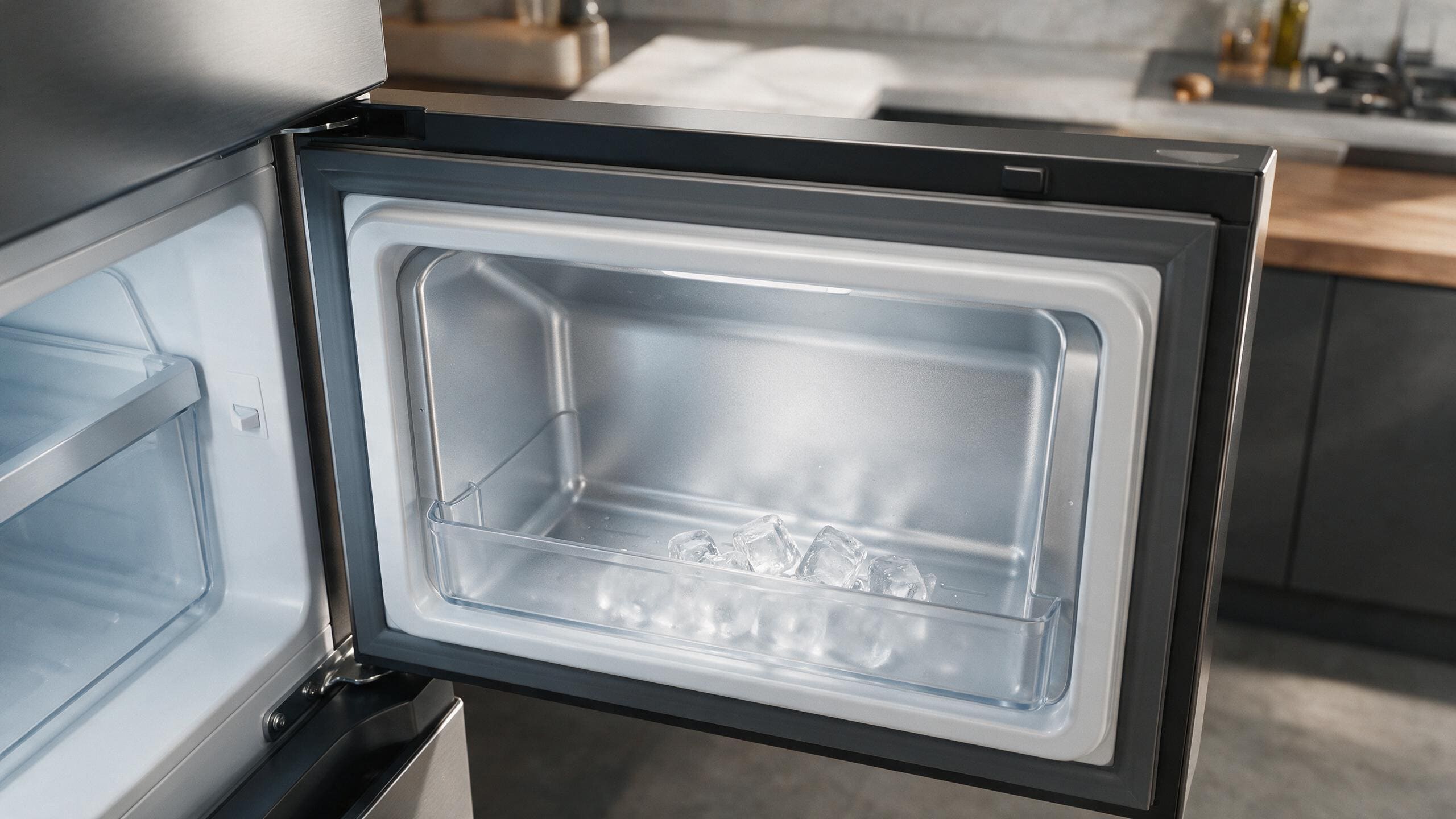
Viking ice-maker troubleshooting starts by separating freezer temperature, water supply, and ice-system behavior before parts are blamed.
When a Viking ice maker stops, the quickest split is cold versus water: is the freezer at its normal temperature, and does the water dispenser or supply still work? On one Viking refrigerator manual, the checks are ice function on, the arm down, the water valve open, water reaching the valve, and no line leaks. If those pass and ice is still absent, book a diagnosis.
An empty ice bin does not automatically mean the ice-maker mechanism failed. Ice production depends on cold temperature, water supply, timing, sensing, and model-specific controls.
If the freezer is warmer than normal, the ice problem may be a symptom of the broader cooling condition. The manual for one Viking 7 Series refrigerator states factory settings of 38°F for the refrigerator and 0°F for the freezer, so a freezer reading far from its setting is worth settling before any ice work.
Measure the freezer temperature and note whether frozen food is also softening. If core cooling is weak, use Viking Refrigerator Running but Warm? Build a Better Cooling Check before focusing only on the ice maker.
On a model with a water dispenser, note whether normal water flow is still available.
If both water dispensing and ice production stopped at the same time, that is useful evidence. If water works normally but ice does not, the diagnostic path can be different. The reverse is also useful: ice that still forms while the dispenser water is weak points toward a different part of the supply than both stopping together.
| Symptom | What it can point to | What you can safely check |
|---|---|---|
| No ice, freezer warm | A broader cooling problem | Measure the freezer temperature before focusing on the ice maker |
| No ice, water works normally | Ice function off, arm raised, or a fault further along | Check the ice function setting and the arm position |
| No ice and no water | A supply problem | Confirm the water valve is open and the line is not kinked |
| Ice stopped after a filter change | Filter seating or flow | Recheck filter installation using the manual |
| Check Water light flashing blue (undercounter machine) | Water supply interrupted | Check the supply; the control looks for water every 20 minutes |
Without forcing motorized parts, check:
Do not pry a frozen tray, force a motor, or apply direct heat to the ice-maker assembly.
After a power interruption, filter change, or empty bin, ice production may not look immediate. Record how long the condition has persisted. Another Viking manual says the first batches from a new undercounter machine may melt, so an early empty or wet bin is not evidence of a failure.
The manual for one Viking 7 Series bottom-mount refrigerator lists the ice function being on, the arm being down, the water valve being open, water reaching the valve, and no line leaks as the checks when the ice maker will not run. Raising the arm stops production, so an arm left up is easy to overlook.
The same manual says the maker produces seven to nine batches per 24 hours and that a new unit needs 24 to 48 hours before ice builds up. It asks you to discard the first three drawers of ice.
Viking’s undercounter clear and nugget machines have their own manual. A flashing blue Check Water light means water supply, and the control checks for water every 20 minutes and restarts ice making on its own once water returns. For low production, the manual lists a restricted drain or standing water in the bin, and condenser fins that need cleaning. It also warns against storing bottles in the bin because labels can plug the drain.
These machines also show a Time to Clean light after six months, and the bin can take eight to ten hours to fill. That is normal behavior, not a failure.
Arrange diagnosis when freezer temperature is normal but ice production remains absent, a tray/motor repeatedly fails to cycle, water leaks, a related code appears, or the same symptom returns after normal user checks.
Use the exact model/E-Nr because Viking ice systems differ across refrigerator families. An undercounter machine has its own manual and its own lights, so do not apply a refrigerator ice-maker checklist to it.
The manual for one Viking refrigerator says to allow 24 to 48 hours and to discard the first three drawers of ice. It describes production of seven to nine batches per 24 hours.
Yes. That manual says raising the arm stops production. Make sure the arm is down and the ice function is turned on.
A flashing blue Check Water light means the water supply needs checking. The control looks for water every 20 minutes and restarts ice making when water returns.
For repair, use Viking Refrigerator Repair.
No. It only confirms part of the water path.
Do not apply uncontrolled heat to plastic, wiring, or sensors.
Model/E-Nr, freezer temperature, whether water dispenses, any code, and a photo of the ice bin or display if helpful.
Share a few details and we’ll confirm an appointment. Prefer to talk? Call us and we’ll help right away.
Use the secure scheduler below to request your appointment.