


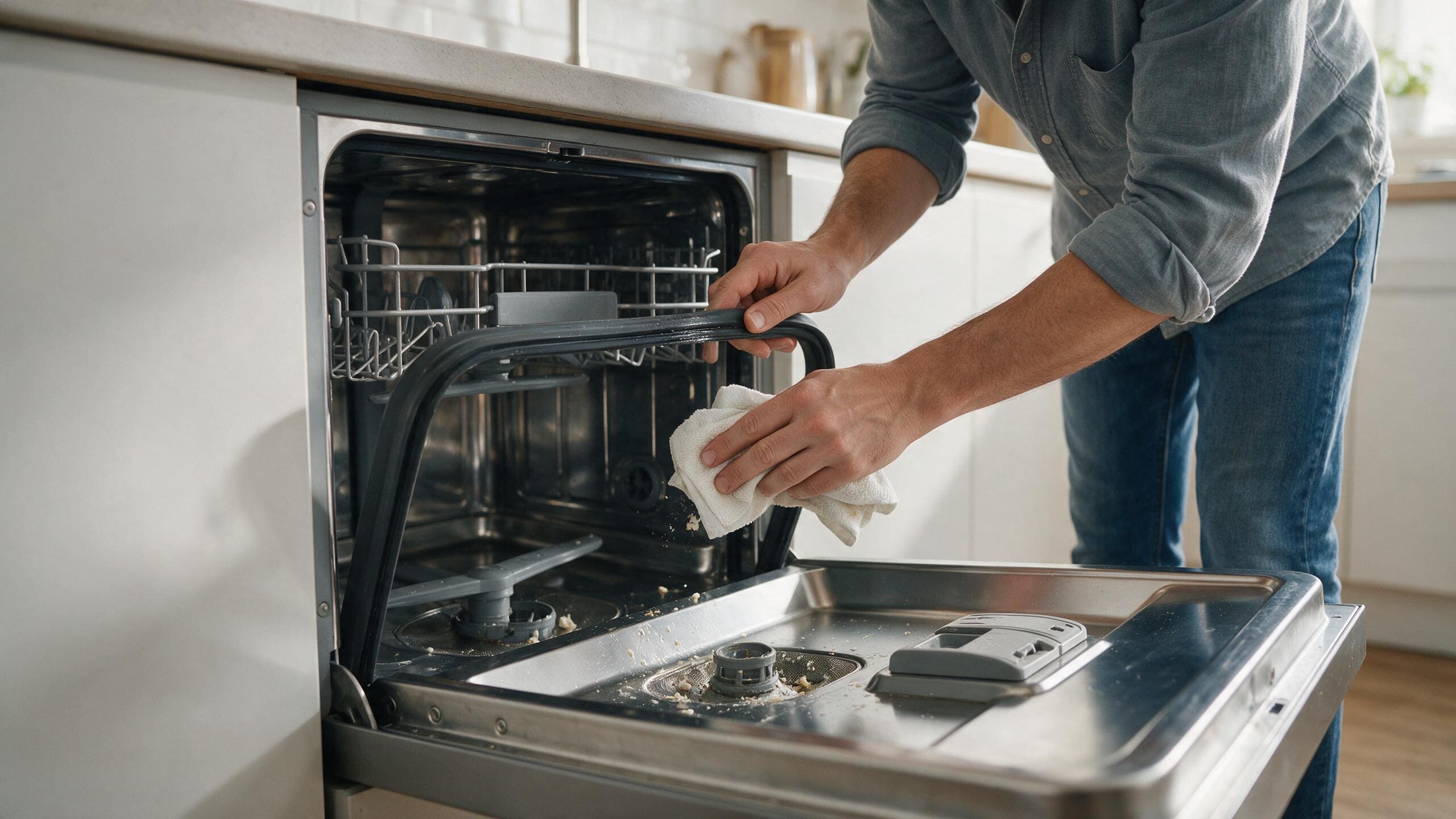
Viking dishwasher odor often starts where food residue and moisture remain. Clean user-serviceable areas and check whether the machine drains fully.
A smell from a Viking dishwasher usually comes from food residue, standing water, or moisture collecting in one place. Clean the filter, wipe the door edge, run the cleaning program the manual describes, and if the odor stays or water remains in the tub, stop and request a diagnosis.
Dishwasher odor is usually most useful as a location clue. Food residue and moisture need a place to remain together long enough for odor to build.
That is why the smell is a useful clue. Where the odor is strongest, and whether water is standing in the tub, often says more than the smell itself.
Clean the user-removable filter according to the model instructions.
If debris is heavy, also ask why it accumulated. Scraping large food residue before loading and regular filter maintenance can help prevent recurrence.
The use-and-care manual for one Viking dishwasher family lists these causes of odor: clogged filters, dirty dishes left in the machine for two or three days, and the peculiar odor of a new machine, which it says fades after a few washes. For leftover dishes, the manual advises removing the remnants, running the Rinse & Hold program without detergent every two days, and leaving the door ajar.
The same manual says to clean the filters at least once a week. It describes turning the micro-filter and coarse-filter assembly counterclockwise and pulling it up, separating the coarse filter by pressing two tabs, cleaning all three parts under tap water with a brush, and reassembling until the coarse filter clicks. It cautions that the sharp outer edge of the main filter can cut, and it says not to run the dishwasher without the filter.
Use the steps in your own manual, since filter designs vary between models.
Wipe residue from user-accessible gasket and door-edge surfaces.
Do not pour bleach or mixed household chemicals into the machine unless the exact owner documentation calls for a compatible product.
Look at the area around the bottom of the door and the edge of the tub. Residue tends to collect where water drains slowly, and a quick wipe there removes what the cycle leaves behind.
Odor plus standing water is no longer only a cleaning problem.
If water remains after the program, use Viking Dishwasher Won’t Drain: A Step-by-Step External Check.
The manual for the same dishwasher family lists clogged filters and a blocked or clogged discharge hose as causes of water remaining at the end of the program. The filter is something you can reach, while the hose is not, so a filter that is clean but a tub that still holds water points to the drain path.
Use the cleaning cycle and cleaning product recommended for the exact dishwasher model.
Run the cleaning cycle with the filter in place and the tub free of dishes. Afterward, check the filter and the bottom of the tub again, because a cleaning cycle can loosen residue that then needs to be rinsed or wiped away by hand.
More chemical strength is not better maintenance.
| What you notice | What it can point to | What you can safely check |
|---|---|---|
| Sour smell with food debris in the filter | Residue buildup | Clean the filter following the manual and scrape plates before loading |
| Musty smell, door kept shut for days | Trapped moisture | Wipe the door edge and leave the door ajar between uses, as the manual suggests |
| Smell with water left in the tub | A drain path or filter problem | Clean the filter and check the water level after the program |
| Smell from under or beside the machine | External moisture or a leak | Look for dampness without pulling the machine out |
| New machine smell | Normal for a new unit | Run a few washes, as the manual describes |
| Smell remains after cleaning | A condition cleaning does not reach | Stop and request a diagnosis |
A damp cabinet area or water under the machine can create odor that seems like it comes from the tub. If you want to track the pattern, note whether the smell is strongest when the door is first opened or only during the wash. A smell that appears only during the cycle often relates to residue, while one that is present at rest relates to moisture or standing water.
If moisture appears outside the normal wash chamber, use Water Around a Viking Dishwasher: Use Leak Timing to Narrow the Cause.
One more source is dishes loaded dirty and left for a couple of days before running. Even a clean machine can pick up odor from that, and the fix is a habit change, not a repair.
The manual for one Viking dishwasher family says at least once a week. Follow the schedule in your own manual.
The same manual says a new machine has a peculiar odor that fades after a few washes. If the odor persists beyond that, look for residue or standing water.
The manual advises leaving the door ajar when dishes have been left in the machine and a Rinse & Hold program has been run. Otherwise, follow the instructions for your model.
Persistent odor with normal cleaning, recurring standing water, or a leak is a reason to request Viking Dishwasher Repair.
Yes. Food residue in the filter can contribute to odor.
No. Residue, standing water, gaskets, and external moisture can all matter.
Do not mix household chemicals. Use model-approved products and procedures.
Share a few details and we’ll confirm an appointment. Prefer to talk? Call us and we’ll help right away.
Use the secure scheduler below to request your appointment.