


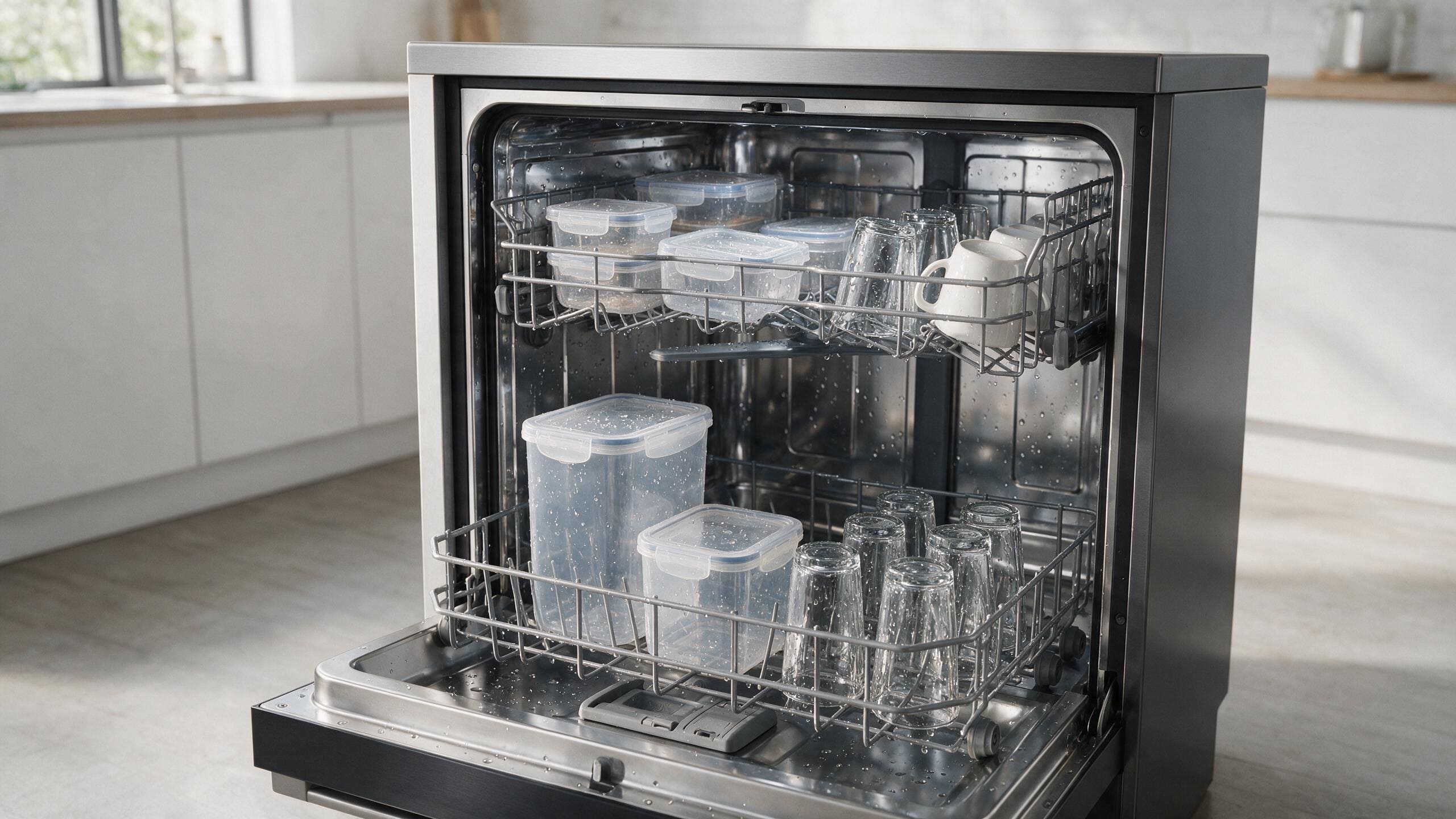
Wet dishes after a Viking dishwasher cycle can depend on material, loading, cycle choice, drying system, or a real heating/drying fault.
Dishes stay wet in a Viking dishwasher most often because of how they were loaded, what they are made of, or how the cycle ended, not because the machine failed. Check for pooled water on recessed items, low rinse aid, and unloading straight after the cycle before suspecting heat. If dishes also come out cool, a code appears, or the change was sudden, book a diagnosis.
Wet dishes do not all mean the same thing. Plastic containers often hold water differently from glass, ceramic, and metal because they cool quickly and have shapes that trap droplets.
The useful question is whether drying performance changed from the dishwasher’s normal baseline. A damp load once in a while after a short cycle is not the same as a machine that used to dry well and no longer does.
If glassware is dry but lightweight plastic remains wet, the dishwasher may be behaving differently than a machine where every item is cold and soaked.
Note which materials are affected.
Cups and bowls that hold pools of water can remain visibly wet even when the dishwasher completed a normal drying stage.
Load items so water can drain from recessed surfaces and so large pieces do not block normal spray or airflow paths. Angling cups and bowls downward is the simplest change, because water that has nowhere to pool has nothing to leave behind.
Different programs can use different wash temperatures and drying behavior.
If the complaint started after switching to a different program, compare the original cycle under a similar load. A short low-temperature program is one of the causes the manual lists for damp dishes, so a quick cycle is a poor test of drying performance.
| Symptom | What it can point to | What you can safely check |
|---|---|---|
| Cups and bowls hold pools of water | Poor loading, so water collects on recessed surfaces | Tilt items so water can run off and keep large pieces from blocking spray |
| Only plastic or non-stick items are wet | Surface material that makes water bead instead of sheet off | Compare with glass and ceramic from the same load |
| Everything is damp and spotted | Low rinse aid | Check the rinse-aid level and the dispenser setting for your model |
| Wet right after the cycle, dry later | Steam still trapped inside when the door is opened | Open the door slightly and let steam escape before unloading |
| Dry results after a short program | Short low-temperature cycle | Run a longer program on a comparable load |
Drying problems deserve more attention when they appear with:
Use Viking Dishwasher Error Codes if the machine reports a warning.
The use-and-care manual for one Viking dishwasher series lists several causes for dishes that are not dry: poor loading that lets water pool, too little rinse aid, unloading immediately after the cycle, a short low-temperature program, and utensil surfaces that have deteriorated. None of those involve a failed part, so they are worth ruling out before anything else. Your own manual may word the list differently, so read the troubleshooting page for your model.
The same manual suggests opening the door slightly at the end of the cycle, letting the steam escape, and unloading the lower basket first. Emptying the lower basket first keeps water from the upper rack from dripping onto dishes that are already dry. Rinse aid is the other lever: when the level runs low, droplets cling instead of sheeting off the surface.
That manual treats drying complaints on non-stick utensils as normal, since water beads on those surfaces. Cloudy glassware or lime traces are a separate topic. The manual ties them to low rinse aid, the water-hardness setting, low salt, or spilled salt, so a film on glass points to settings rather than to the heating system.
A dirty filter can affect water movement and overall cycle performance, but cleaning it is not a universal cure for a drying complaint. The manual for one Viking series lists clogged filters as a cause of other problems such as odor, so a filter that has gone unwashed is worth ruling out as part of the same pass.
Use How to Clean a Viking Dishwasher Filter Without Turning Maintenance Into Repair for the maintenance step.
The manual for one Viking series suggests opening it slightly and letting the steam escape before unloading, with the lower basket emptied first. Pulling everything out at once can leave items looking wetter than they are.
One Viking manual says drying complaints on non-stick utensils are normal because water beads on those surfaces. If glass and ceramic from the same load come out dry, the dishwasher is behaving as expected.
The manual for one Viking series lists low rinse aid, the water-hardness setting, low salt, and spilled salt as causes of lime traces and misty glassware. Check those settings in your own manual before looking at the machine itself.
If drying changed suddenly and remains poor across comparable loads, request Viking Dishwasher Repair.
Plastic commonly retains surface water differently from glass or ceramic. Compare the whole load and previous performance.
Use the product and dispenser settings described for the exact dishwasher model.
Not automatically. Cycle behavior, loading, material, heating, sensing, and model-specific drying systems can all matter.
Share a few details and we’ll confirm an appointment. Prefer to talk? Call us and we’ll help right away.
Use the secure scheduler below to request your appointment.